
Why Your Amazon Cart Just Got More Expensive: How Sellers are Hiding New Fuel Surcharges in Product Dimensions
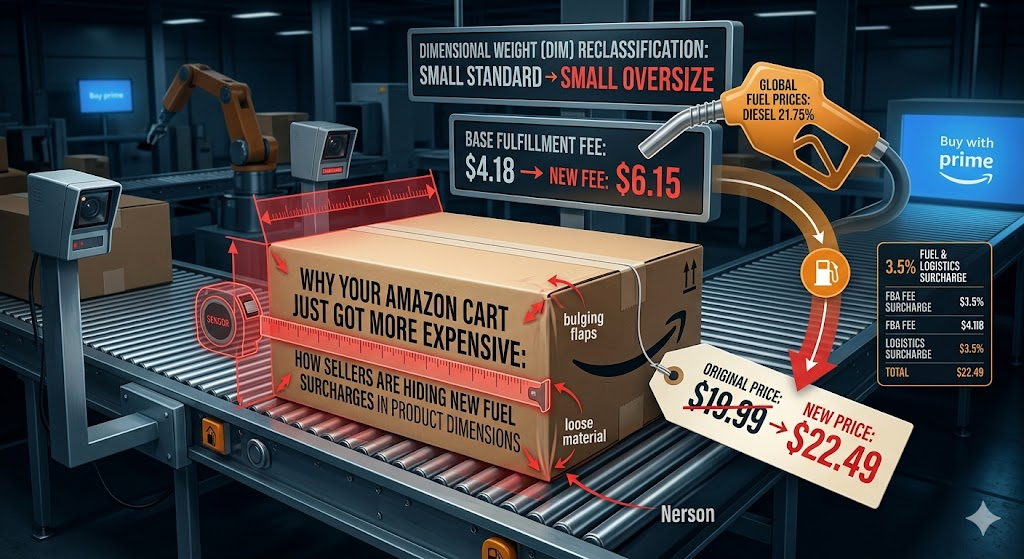
Your Amazon cart has likely been getting pricier due to a combination of explicit new fees from Amazon and strategic, less visible cost-shifting by sellers facing skyrocketing logistics costs.
While sellers generally cannot directly edit product dimensions in a way that tricks Amazon into charging a higher shipping fee that they pocket—since Amazon physically remeasures items at their fulfillment centers—the logic connecting these elements centers on "Dimensional Weight" and Size Tiers.
Here is a breakdown of how fuel surcharges work and how product packaging, dimensions, and size tiers are driving up the final price you pay.
1. The Explicit Reason: New and Increased Fuel Surcharges
In 2026, the cost of moving parcels has risen dramatically. To recover these costs, major logistics providers and marketplaces implemented new surcharges:
- Amazon’s Fuel Surcharge: Effective April 17, 2026, Amazon added a 3.5% “fuel and logistics-related surcharge” on every FBA (Fulfillment by Amazon) fulfillment fee in the US and Canada.
- Crucial Detail: This surcharge is not a percentage of the product's sale price or shipping cost. It is a percentage of the seller's fulfillment fee (the price Amazon charges them to pick, pack, and ship). A standard-size FBA unit now costs sellers roughly $0.17 more on average, though this varies by the item's size and weight.
- Carrier Increases: Major carriers like UPS have structurally reset their fuel tables upward. In January 2026, UPS increased Domestic Ground and Domestic Air fuel surcharges to 21.75% and 21%, respectively. International air surcharges are even higher, ranging from 24% to 31%.
2. The Invisible Mechanics: Dimensions, Size Tiers, and Cost-Shifting
The core of the issue is not that sellers are dishonestly changing dimensions, but rather that Amazon’s fee structure penalizes larger dimensions heavily, and those costs are passed to you.
The Role of "Dimensional Weight"
Logistics companies don't just charge based on actual weight. They use Dimensional Weight (Dim Weight), which is calculated as (Length x Width x Height) / Divisor. The shipper is billed for the greater of the actual weight or the dimensional weight.
- The Consequence: A large, lightweight box (like a package of cotton balls or a small pillow) can be billed at the same weight as a small, heavy box.
The Trap of "Size Tier" Boundaries
Amazon uses specific dimension and weight thresholds to place items into "Size Tiers" (Standard, Oversize, Extra Large). Moving into a higher tier causes a significant jump in the base fulfillment fee on every order.
- The Trap: Amazon’s automated scanning sensors at fulfillment centers capture packaging edge-to-edge. Any loose poly bag material, bulging package flaps, or protruding handles can trigger a sensor, reclassify an item into a higher tier, and instantly increase the seller’s fee.
3. How This Results in a Higher Price for You
If a seller's costs rise due to the 3.5% fuel surcharge, or if their item is bumped into a higher size tier due to a packaging quirk or dimension recalculation, they must find a way to maintain their margins. For a seller moving 10,000 units a month, a small fee increase like the fuel surcharge alone can add $1,500 to $3,500 monthly in new costs.
They pass these compounded costs to you, the consumer, in two primary ways:
Increased Listing Price
- The seller raises the explicit price of the product (e.g., $19.99 becomes $20.99).
- Visible to you, but the reason for the increase is hidden.
Decreased Discount/Coupon
- The seller removes a recurring coupon, sale price, or "Buy with Prime" discount.
- High impact on final cost, but the item appears unchanged on your screen.
In summary, your cart is getting more expensive because a compounding cycle of rising diesel costs and structural logistics fees are squeezing seller margins. These sellers are forced to raise prices or reduce discounts to cover the costs of the 3.5% surcharge and the increased fee liability that larger dimensions trigger.