
The Trojan Horse in the Shopping Cart: Inside Amazon’s Agentic Retail Play
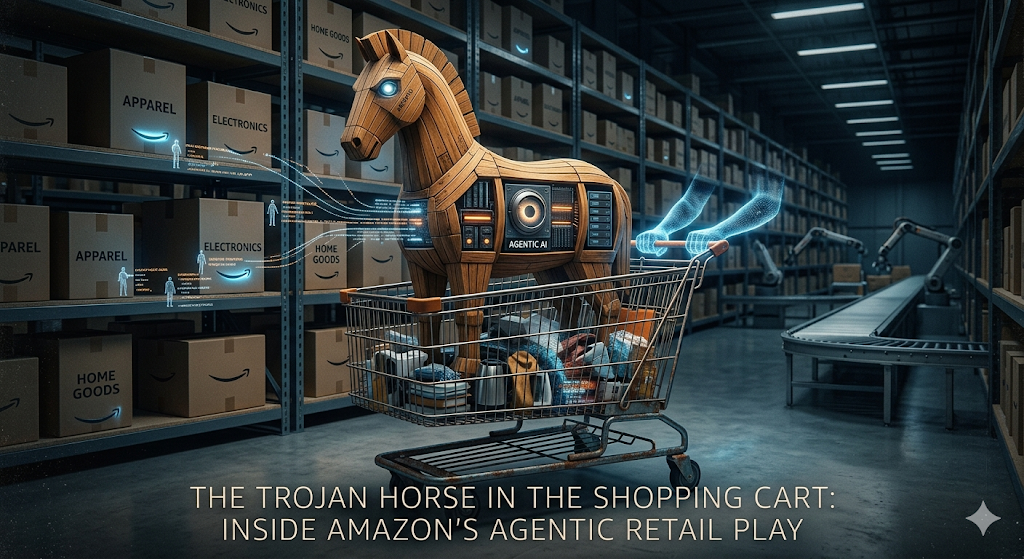
Amazon has officially destroyed the barrier between partner and competitor in retail by launching the Agentic Shopping Assistant (ASA) service.
Similar to how the company transformed the way we consume cloud computing with its own multi-billion dollar AI powered e-commerce engine (‘Alexa for Shopping’) behind the ‘Everything Store’ and then proceeded to monetize the rest of the cloud computing industry by packaging the same technology into a service called AWS and building a huge compute flywheel (as evidenced by the recently announced $25 billion capital commitment to Anthropic), Amazon is now packaging the exact same technology into a service that it will monetize off of by becoming the de facto AI infrastructure for all of retail.
The initial customer for this ‘service’ is Tapestry (Kate Spade etc.) who will be using Bedrock and Anthropic’s Claude models for a highly personalized gift concierge service.
The Double-Agent Dilemma: Innovation vs. Leakage
The Agentic Shopping Assistant (ASA) from Amazon AI is another retail innovation sure to change retailing.
The privacy concerns and vendor lock-in required for retailing with such strong information gathering capability, as Amazon’s Bedrock can, for example, gather a long list of ‘telemetry’ as customers interact with a retailer’s retailing ‘agentic’-powered Shopping Agent, are of great concern.
But, Amazon has given all retailers a great blueprint for creating their very own ‘Shopper’s AI Agent’ and, in doing so, greatly enhancing the customer experience for their customers. For most retailing companies, the back-end intelligence of the various ‘Shopper’s AI Agents’ will be utilizing the same powerful retail AI that powers ‘Alexa for Shopping’ (a service from Amazon AI) via a cloud service created by Amazon AI.
Here we see a great 60-day blueprint for the Structural Intelligence Leakage that will obviously occur in order to enable a retailer to very quickly save 18 months of very expensive retailing ‘engineer’ work, in creating their very own, unique and exclusive retailing ‘agentic’-powered retail experience, whilst working within their existing retailing structures.
The Compute Flywheel
Once a retailer has built-out their Bedrock-powered retail AI ‘flywheel’ for example, their competitors will then be able to use their own, hugely expensive, capital to compete against the retailer in real-time for each and every one of the retailer’s customers’ retail interactions.
Therefore, in order to use such a service as Bedrock, created by the world’s greatest retailing company in terms of AI development thus far, via a “cloud-service” that will only cost the retailer to use (or “compute”) on a per-interaction basis, the retailer will need to work out how they wish to use the very powerful platform in order to compete with other retailing companies.
Technical Mitigations: The "Shield" and the "Shroud"
1. Vector Isolation via Hybrid-Cloud
For the majority of retailers, this will mean isolating the telemetric data of their customers from other intelligence structures (or “systems”) that they may utilize, via a Hybrid-Cloud architecture, and then implementing Vector Isolation, within which only “sanitized” vector embeddings are able to be passed to the platform.
The majority of data will remain on neutral cloud grounds in order to create a huge “data-wall” around core customer structures and related inventory structures whilst allowing retailing AI vectors to be created in order to “search” across the entirety of a company’s possible product range within that retailer’s specific retail space.
2. The Open-Source Orchestration "Shroud"
The Open-Source Orchestration “Shroud” will also be required, in order to allow all retailing companies to remain freely agile in the retail AI space created by this powerful platform, whilst working to create their own, unique and exclusive retailing ‘agentic’-powered retail experiences, and ensuring that all of the elements used to power such experiences remain within their full sovereignty at all times.
The vast majority of retailing AI vectors are created within a retailers’ retailing AI and then sent to external providers and platforms such as Bedrock for processing in order to return highly-relevant results within a retailers search-space (as described within The Search Problem).
The Strategic Path Forward
There are huge advantages that can be accrued when utilizing retailing AI, which is why every single retailing company must work towards creating a high degree of Retailing AI Savvy.
This is necessary in order to be able to develop and execute retail strategies and remain competitive, allowing customers to retrieve any piece of information relating to that retailer and that retailer’s products at any time and from anywhere that they choose to search from, within that retailers unique and exclusive retail space, via their AI-powered Shopping Agent.
This is now a standard customer expectation for people globally, as they can now use conversational methods in order to achieve any goal that they wish to, whilst also allowing retailers to provide each and every customer with their very own, highly-personalized “Store” that will always be ready and waiting for them at any time, 24/7/365.