
The Psychology of the Smaller Box: Why Shrinkflation Tricks You Into Buying Twice as Much
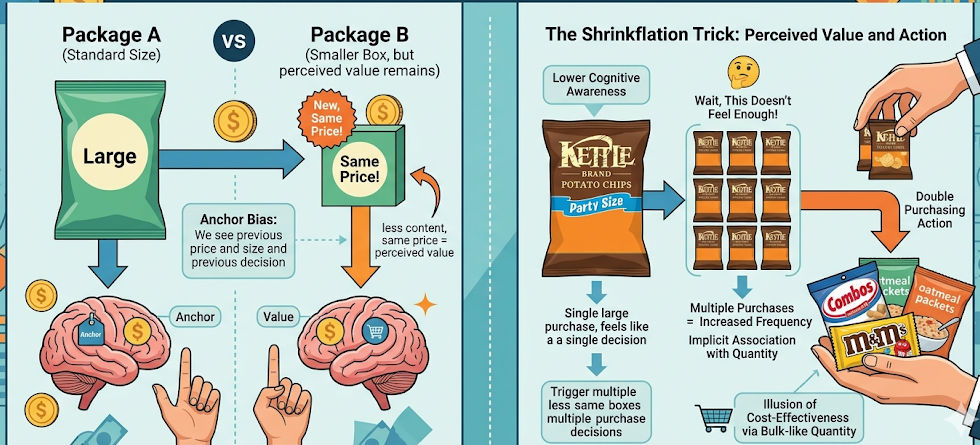
Shrinkflation—maintaining a static nominal price point while reducing package volume—exploits systematic blind spots in human visual perception and cognitive accounting. Consumers do not evaluate volume mathematically; they evaluate packaging heuristically. This cognitive friction triggers compensatory buying behavior, ultimately increasing absolute purchase frequency and volume.
1. The Weber-Fechner Law & Just Noticeable Difference (JND)
The human brain fails to register down-scaling if the change falls below a specific statistical threshold. This is governed by the Weber-Fechner Law:

If a manufacturer cuts package volume by 8% or less, the human eye structurally fails to perceive the difference on a retail shelf unless directly compared side-by-side with old stock.
2. The Dimensionality Bias (The 3D-to-1D Scaling Trap)
When packaging volume is reduced, manufacturers do not scale down all three dimensions equally. Humans estimate volume changes primarily based on changes in height or frontal surface area (1D or 2D) rather than depth or thickness (3D).
If a box's volume is cut by 15%, a proportional reduction in all dimensions would decrease the height by only 5.3%. Manufacturers often decrease the depth (thickness) of the container while maintaining front-facing height and width. On a grocery shelf, the 2D visual footprint remains unchanged, maintaining the illusion of the original value.
3. The "Consumption Velocity" Feedback Loop
Shrinkflation actively drives the user to "buy twice as much" via accelerated depletion cycles:
- Static Portion Anchoring: Consumers possess entrenched behavioral anchors (e.g., "one bag of chips per week," "two scoops of coffee per morning").
- The Depletion Shock: When volume drops below the threshold required to sustain the habit cycle, the consumer experiences an unexpected out-of-stock event at home.
- The Compensatory Response: To mitigate future stockouts and re-establish equilibrium, the buyer alters their purchasing behavior on the next retail trip—switching from buying one unit to buying two units (or an extra "buffer" unit), accelerating total top-line revenue for the manufacturer.