
The End of Browsing? How Amazon’s New Upgrades are Quietly Redefining How We Shop
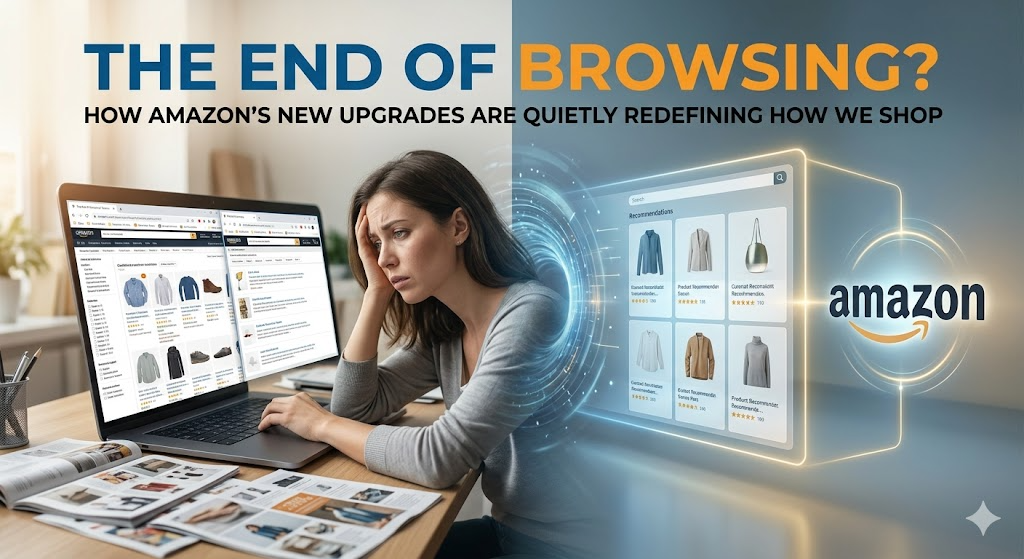
For the last decade of online shopping, you open up the app of your preferred retailer, search for a product or service and then browse through the resulting pages of sponsored links, mediocre products, fake reviews and in the end you buy the best one after thorough consideration of all the above factors.
For several months now, Amazon has been announcing behind-the-scenes upgrades to shopping on the platform. A recent press release exposed Amazon’s move away from shopping with the archaic keyword-based search function and towards ‘agentic’ AI and ultra-local logistics. As a result, ‘browsing’ for products online could be a thing of the past in just a few short months.
However, many consumers have not updated their Amazon shopping app recently. In order to bring readers up to speed on the various recent updates to the app, a look at the recent changes to the online retailer and the effect that they will have on the consumer and the price of items will be provided in the following three sections.
1. Meet "Alexa for Shopping" (Goodbye, Rufus)
Quick Update: Orange icon Rufus is no longer supported by Amazon. All features of Rufus have been incorporated into an upgraded and even more omnipresent version of the AI-powered shopping agent, Alexa for Shopping, which is already integrated into the search bar of the Amazon Shopping app.
What can it actually do?
- Deep Personalization: Amazon is now tracking and using a far more in-depth dataset of personal information to provide deeply relevant results to search queries such as “shampoo” which is based on your About You profile plus new information such as your hair type and preferred shampoo ingredients, which could mean you’re shown all the shampoos that are best for your hair and include the exact ingredients you like to use.
- 1-Year Price History: For the last year or so, customers have been able to see a historical price for a product in Amazon’s shopping cart. Well, after listening to customer feedback, Amazon is now displaying a 1-year price history right on the product page, for every product. This is really helpful when determining whether or not that “Limited Time Offer” really is a deal.
- AI ‘Scheduled Actions’: Shoppers can set ‘Scheduled Actions’ with the new service. For example, a customer could tell Amazon’s AI to add a product like a tube of sunscreen to their shopping basket. But there’s a twist: the AI can be set to add the sunscreen to the shopping basket when it drops in price to $10. There is another condition though. The AI won’t add the item to the customer’s shopping basket until two months have passed since they last purchased a similar item.
The Takeaway: It’s going to act as your shopping agent. It will look for products which would meet your needs and wants. It will attempt to remove as much work from your purchasing process as possible by narrowing down the items for you to compare.
2. "Amazon Now": The 30-Minute Emergency Run
Running for the 30-Minute Emergency Run, Amazon Now is a service to get customers what they need in 30 minutes or less. This new service will operate from small, highly localized urban fulfillment centers and will not be a service to buy big items like a flat-screen TV. It will be more for customers to get things that they need immediately. For Prime members, delivery will be $3.99 per order. Non-Prime members will pay $13.99 per order plus additional fees for orders under $15.
Amazon is taking on the quick commerce offered by Instacart, DoorDash, and Uber Eats among others. With the expansion of 1-hour and 3-hour delivery to over 90,000 products, Amazon is also going to make ordering from Amazon as fast or faster than customers can get in their car and go to the local convenience store.
3. The Big Picture: What This Means for Consumers
We take a closer look below at the details behind each of the features mentioned. We then proceed to provide comments on what all of this means for the consumer.
- The Death of Discovery: While Amazon’s updates to its shopping experience will save consumers a great deal of time when searching for a periodic purchase, there is a chance that this system may also decrease the chances of a consumer discovering items at independent retailers and small companies.
- The Privacy Trade-off: To get the most out of “Alexa for Shopping,” you have to feed the system intimate details about your lifestyle, household, budget, and family members.
- The Future of Irresponsible Buying: With shopping agents now more easily available than ever before, your ability to be an irresponsible shopper will increase dramatically. As your home’s shopping agent, it will become even easier to purchase items on impulse and allow your budget to control you.
Your Turn to Weigh In
What are your thoughts? Do you think it would be awesome to have an AI shopping agent and for it to automatically add items to your shopping cart when they go on sale? Or is Amazon collecting too much information about you and your household?
Amazon is basing the new shopping features off of the requirement of 30 minute or less delivery. Do you think that is fast enough for you? Or will 1 day shipping be sufficient?