
The Decoupling: Why Amazon is Opening Its Physical Supply Chain to Competitors
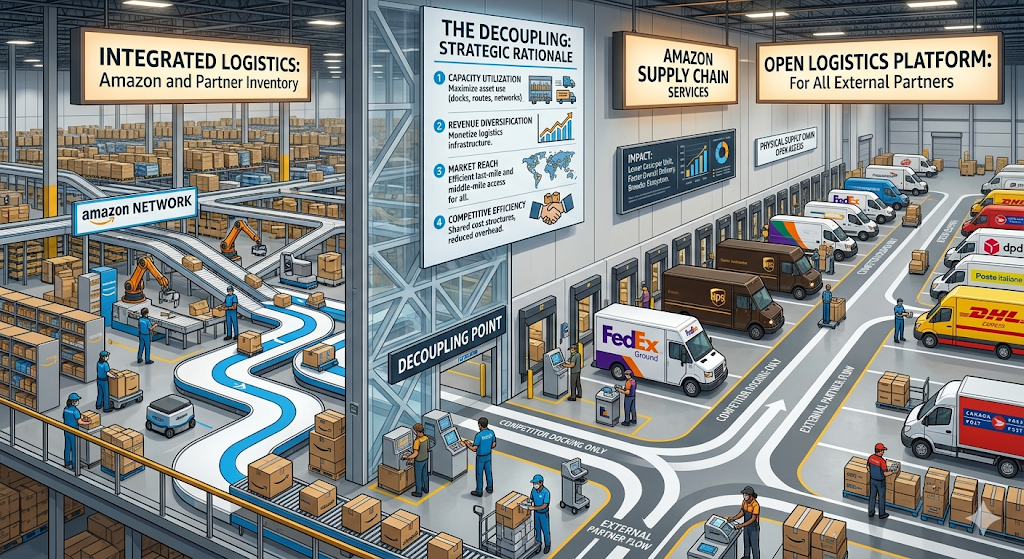
For over two decades, Amazon developed a retail moat of physical supply chain assets – a multibillion-dollar network of facilities, planes, and delivery vehicles to serve Amazon customers, who shopped on Amazon.com, Amazon Marketplace, and other retail properties owned by the e-commerce leader.
Amazon Opens Up Its Physical Supply Chain To Competitors
In the major expansion of its Amazon Supply Chain Services (ASCS) for physical supply chain management of packages, Amazon for the first time ever is decoupling its physical supply chain infrastructure from its online retail store, Amazon Marketplace. The new infrastructure will enable the e-commerce giant to warehouse, to ship, and to deliver for companies other than Amazon — including direct-to-consumer (DTC) brand manufacturers selling in their own stores, such as retail and webstores on platforms like Shopify, traditional offline retailers, as well as wholesale distributors to other types of retailers.
The test clients for Amazon Supply Chain Services are well-known companies such as American Eagle Outfitters, Lands’ End, and Procter & Gamble.
This is the “AWS-ification” of physical logistics. But for brands, this transition introduces a critical tactical choice: Do you leverage the world’s most optimized supply chain, or do you guard against letting a fierce competitor control your operational lifeblood?
1. The Playbook: Replicating the AWS Trajectory
To better understand Amazon’s decoupling strategy, we will first explore how Amazon Web Services (AWS) became as dominant as it is today in the technology space.
Back in the early 2000s, Amazon had to build a huge amount of server capacity to deal with the growth of Amazon.com. As it did, it realized that it had built a highly scalable computing product that it could then sell to other developers and companies as a utility. And thus Amazon Web Services (AWS) was born, and it has become an extremely profitable division of Amazon.
Amazon is creating a utility that it can offer up to external developers and companies in exactly the same way that it has offered up the Amazon Web Services computing platform. The physical supply chain is being rearchitected along four operational dimensions:
- Asset Class Evolution: Amazon is evolving the physical supply chain asset class from a physical supply chain of a single retailer (Amazon the retailer) to a physical supply chain asset class that can serve any number of retailers and products, and support a wide array of distribution and shipping scenarios.
- Monetization Architecture: The way in which Amazon has created a huge margin between what it charges its customers and what it costs to provide them that service has been replicated for the services offered by ASCS. Instead of charging the customer up front for the space that they require, ASCS is charging them on a pay-as-you-go basis for the actual services that they use (freight, distribution, storage, parcel delivery, etc.).
- Scale Inception Point: AWS was originally designed to handle the extreme volumes on Amazon.com during peak shopping periods. Similarly, ASCS can handle extreme volumes of inventory and shipments for customers on the service. Traditional 3PLs get overwhelmed during peak times, but Amazon’s massive FBA marketplace creates a natural environment to test and refine the ability to scale in real time.
Operating physical assets as open utilities allows Amazon to keep all of its regional and local hubs running at full capacity on an ongoing basis, as opposed to Marketplace which sees large drops in volume on an annual basis.
2. Why Brands are Transitioning (The Pros)
For enterprise DTC and mid-market brands, using Amazon’s logistics engine can be very beneficial.
- Cost of Last-Mile Delivery: Amazon is able to charge less than every other carrier for last-mile delivery because of the volume of local delivery routes it is able to service on a daily basis. This typically results in flat rates for last-mile delivery and does not include residential delivery charges or dimensional weight increases that are typically levied by other carriers.
- Inventory Management – Hyperlocalization: Instead of holding stock in five distribution centers around the country to hit a 2-day shipping threshold, brands can hold their stock in Amazon’s fulfillment centers. At peak, the inventory will then be moved to the micro-fulfillment center nearest to the customer for same-day or next-day delivery. The algorithm will have previously determined the best locations for each brand’s SKUs based on purchasing history.
- Simplified Multi-Channel Inventory Management: One of the simplest ways that a brand can add a DTC Shopify store to their existing retail and wholesale businesses is to use the same inventory for all of the channels. Amazon’s sophisticated routing algorithm will distribute inventory from a single inventory pool to the correct location for each order.
3. The Skepticism: Redundancy, Data, and Trust
The error of supply chains being severely impacted by large supply chain crises, such as the one caused by the COVID-19 pandemic, is that the brands impacted had placed an excessive amount of exposure to the failure of a single supplier or even a single location. Therefore, allowing a third party to manage all of the DTC distribution for a brand would put that brand’s DTC distribution at an increased risk of failure.
The Redundancy Trap (SPOF)
The risk of supply chain failures in the past has revealed to companies just how big of a problem it can be when all of your eggs are in one basket. As is the case with the advantages to using Amazon’s logistics for sales on Amazon as well as DTC off of Amazon, there is also significant risk of failure. Should there be a labor strike at one or more of Amazon’s fulfillment centers, or should there be a problem with their API on Black Friday, the potential for huge losses as all of the online as well as the offline sales fail simultaneously is very real.
The Competitive Intel Leak
So even when a brand is using the very low-cost advantages of Amazon’s logistics for their on-platform sales (for which they pay a variable margin and are subject to all of the terms and conditions of Amazon Services Crossing Borders), and for their off-platform DTC volume (for which they pay a fixed fee per unit for access to Amazon’s global infrastructure and are subject to all of the terms and conditions of ASCS), Amazon will have access to highly sensitive Competitive Intel about the brand for as long as they are using the cost advantages of Amazon’s logistics for those sales.
Through this, Amazon can potentially see:
- Which of your SKUs are growing fastest off-platform.
- Your customers' individual purchase frequency and their individual average order value.
- Which regions will command the highest margins for you and your competition for identical products.
These types of Competitive Intel Leaks (CILs) can also have severe consequences for brands that offer private label products (e.g., Amazon Basics SKUs), as they could pose significant anti-competitive compliance risks to competitors who sell the same products.
4. The Action Plan: The Hybrid "Force-Through" Strategy
Forward-thinking brands are planning to utilize Amazon’s cost-effective supply chain and shipping services to enhance their supply chain while running their DTC and wholesale channels in a safe and compliant manner. A hybrid supply chain approach is the required strategy to achieve these goals.
Step 1: Cap the Volume of Brands that Use ASCS for Off-Platform Sales
For your Shopify DTC channel, wholesale channel, and retail channel, never allow Amazon to handle more than 60% of your off-platform volume. Send the balance, 40% or so, to a hard, independent 3PL.
Step 2: Implement Real-Time Middleware Routing
We would recommend the use of an inventory management tool that includes failover logic or real-time automated workflows, switching 100% of pending orders to alternative nodes (i.e., 3PL) should there be excessive latency from ASCS.
Step 3: Utilize a Data Masking Proxy
Next, in order to send the information to Amazon’s servers while keeping from sending too much information, Data Masking Proxy software must be installed and configured to change sensitive information—such as information that contains SKU numbers, customer names, addresses, email addresses, phone numbers, etc.—prior to transmitting the information. This information can be of extreme value to your competitors, and therefore you should reformat the sensitive information by using letters and numbers to represent it, such as changing SKU numbers to something like "ABC123", or changing customer names to "XXXX", etc.
The Verdict
Amazon Supply Chain Services is one of the biggest B2B retail changes of the year. While it brings world-class logistics to the masses, it also creates huge needs in terms of compliance and risk management for brands using the service.
The brands that win in 2026 will be those who recognize Amazon’s potential as a highly optimized utility provider for their logistics and have a well-thought-out plan for managing that relationship.
Amazon’s ASCS B2B service certainly appears to offer a number of benefits to companies who want to make better use of their supply chain investment. However, are the potential risks of exposing sensitive information worth the benefits of passing packages through Amazon’s ‘cost-saving’ logistics service?